One of the first “moving pictures” ever created is a moving picture of a horse. In the late 1870s, the photographer Eadweard Muybridge produced a series of “chronophotographs” of horses and riders, including the famous 12-frame sequence Sallie Gardner at a Gallop. I know about Muybridge’s work thanks to Jordan Peele’s film Nope, which considers the historical erasure of Sallie Gardner’s Black jockey, whose identity is disputed. Another thing that easily gets overlooked when considering these images is their contribution to the practice of horse-breeding.
Muybridge – who, incidentally, murdered his wife’s lover, which doesn’t seem wholly irrelevant here – captured the images after many years of tinkering with shutters, triggers and emulsions, but they were commissioned by the industrialist Leland Stanford, founder of the university of the same name. Stanford kept racehorses, and wanted a more precise understanding of their movements, with the obvious wider motive of being able to raise more champions; nowadays, gait analysis by means of video capture is commonplace among breeders. Muybridge’s breakthrough in terms of photographic reproduction is thus an important development in control of equine reproduction. To stretch that point a little, you could argue that the moving picture has always been a way of disciplining sex – and one animal may seem much like another, once reduced to a quantity of frames.
Those lineages combine in Santa Ragione’s ugly and disquieting artwork Horses, which explores how bodies are constrained, operated and degraded by media technologies that range from early silent movies all the way to the grotesque and choppy sorcery of videogames. Released today, the game has been rejected by Steam, the world’s largest PC gaming storefront, on the grounds of being an obscenity, based on an earlier, work-in-progress version that isn’t publicly available for review. This is both a potential financial disaster for Santa Ragione, and a torturous performance of the gameworld’s own inhibitions.
Save for some title screen footage of a pink and green meadow, Horses unfolds in shades of rickety grey. Starting the game, you catch glimpses of a film projector. It gasps to life, and from there on, everything you see implicitly emerges from that projector. You hear its soporific whirr throughout, lifted fleetingly by music that includes tracks redolent of modern horror movies, and mock-jaunty asides that recall the live piano accompaniment for older silent films. The world is otherwise soundless, which is welcome, because if Horses were fully audible it would consist mostly of screaming.
Horses entangles these cinematic devices with the workings of what could almost be a first-person Stardew Valley. It takes place on a 3D farm estate about the size of the average FPS multiplayer map, with a house, a paddock, a vegetable garden, a rolling cornfield, and an overpopulated graveyard. You are a harrowed young man of around 20, sent to the Farm by your parents to make something of yourself over two weeks of honest labour.
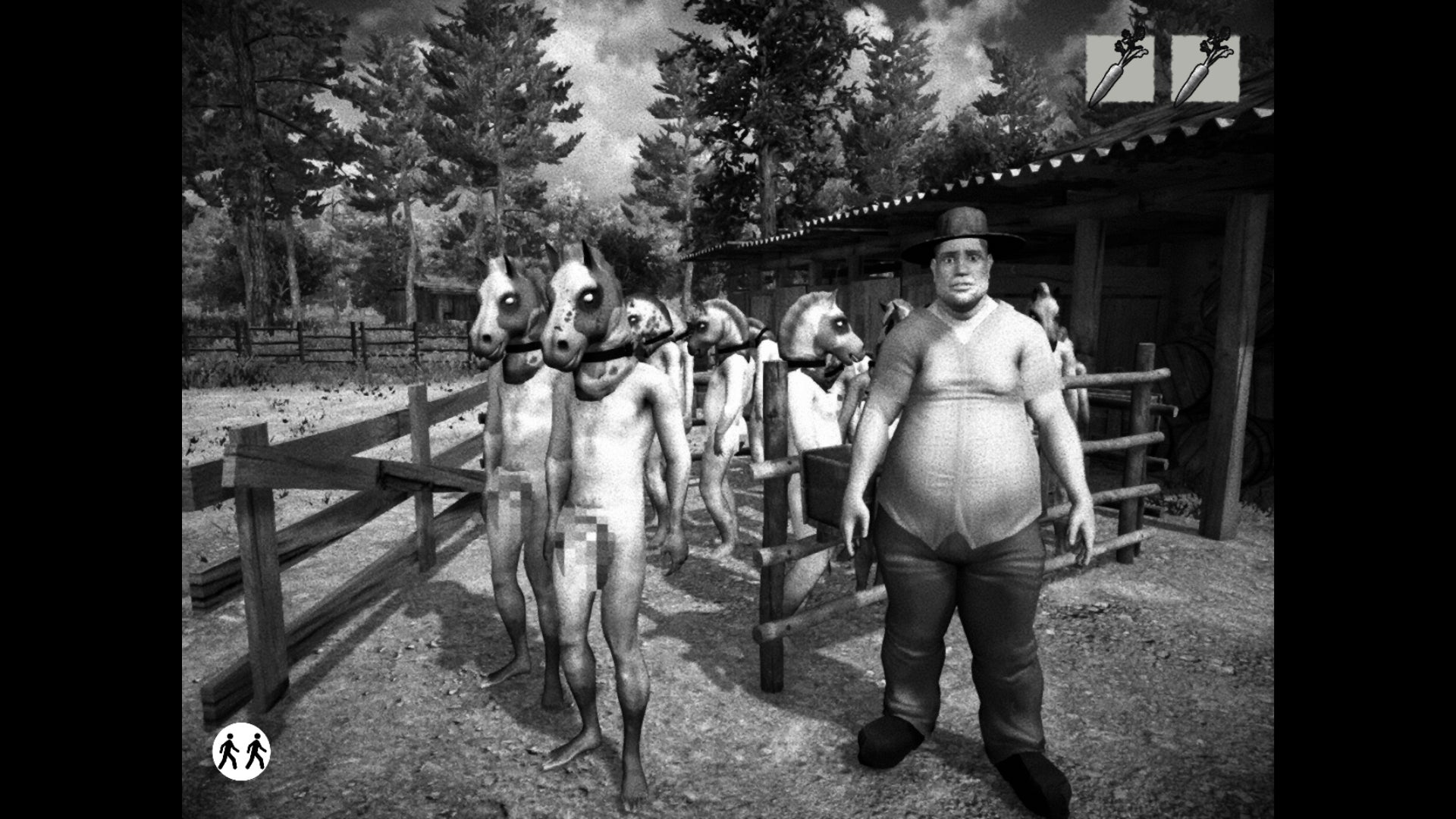
There are the rudiments of a conventional farming sim here – an inventory bar, tool icons and the suggestion that plants actually grow between visits – but the presentation keeps yanking you back into the realm of cinema. Dialogue is delivered by title cards. Actions such as watering the potatoes are illustrated by scratchy live footage. Sometimes you hallucinate, and the reassuringly false digital world films over with vistas of rippling, fleshy horses. There’s a kind of kinky antagonism here. Rather than being complementary in the triple-A sense of “cinematic visuals”, or working around limited resources for digital modelling and animation, it’s as though the older technologies of representation were repeatedly frustrating the younger.
The game’s “horses” are similarly at odds with themselves. They are naked and branded male and female human slaves in horse masks, their genitals, breasts, and arseholes blurred out so as to perform a double brutalisation – at once stripping them bare, and pixelating them in disgust.
The depiction of the “horses” recalls the actual treatment of slaves throughout what we are pleased to call civilization, but there are also ironic references to how certain videogame conventions perform bodily subjection, in echo of Leland Stanford’s designs for the emerging technology of chronophotography. One day, you’re sent to round up two stray “horses”. This involves adding them to your hotbar inventory like items, via the button prompt “tame”. In the process, you’re shown a rotatable T-posed character model, a spectacle familiar from countless asset libraries. Get it? Tame-posed.
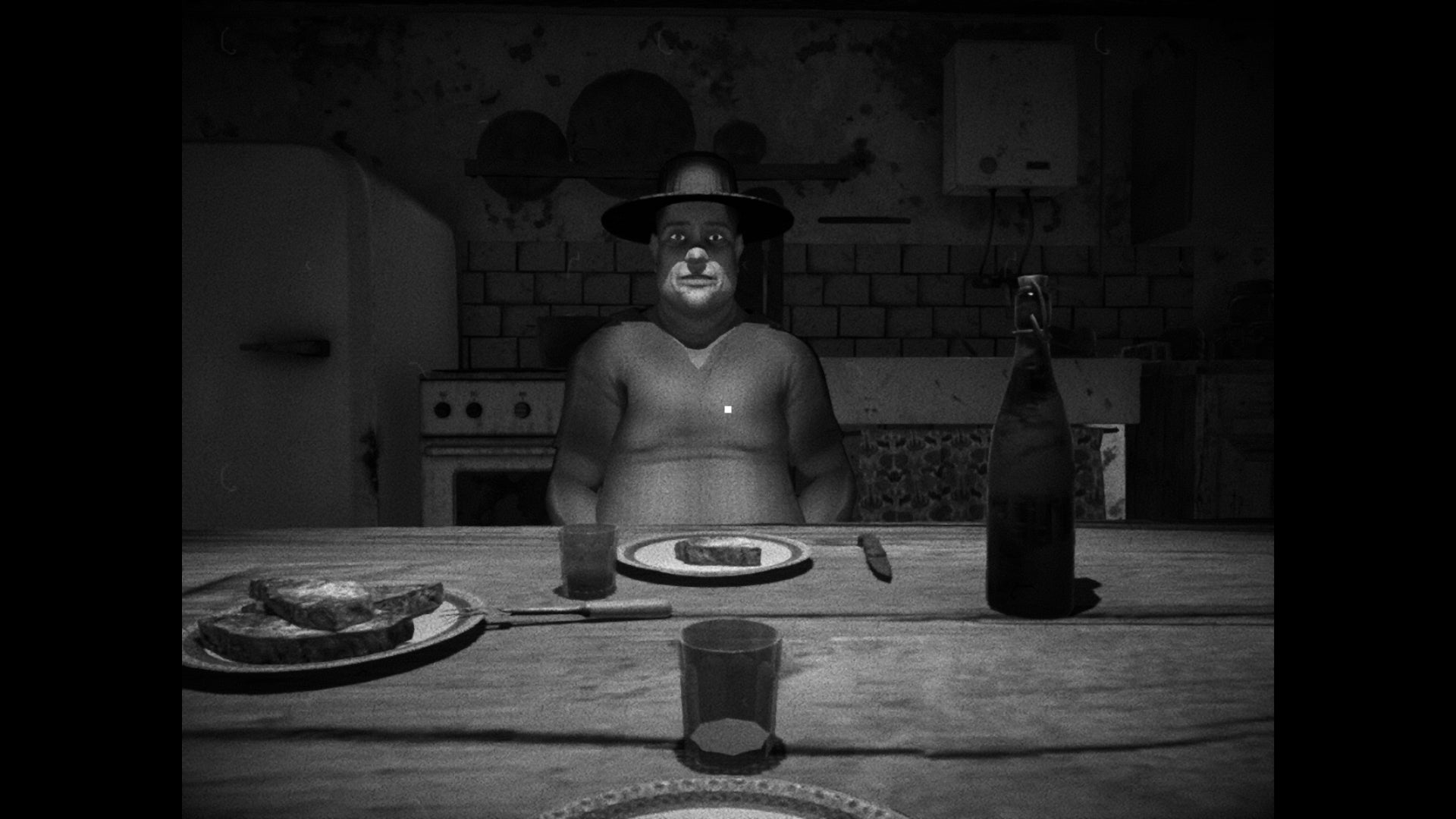
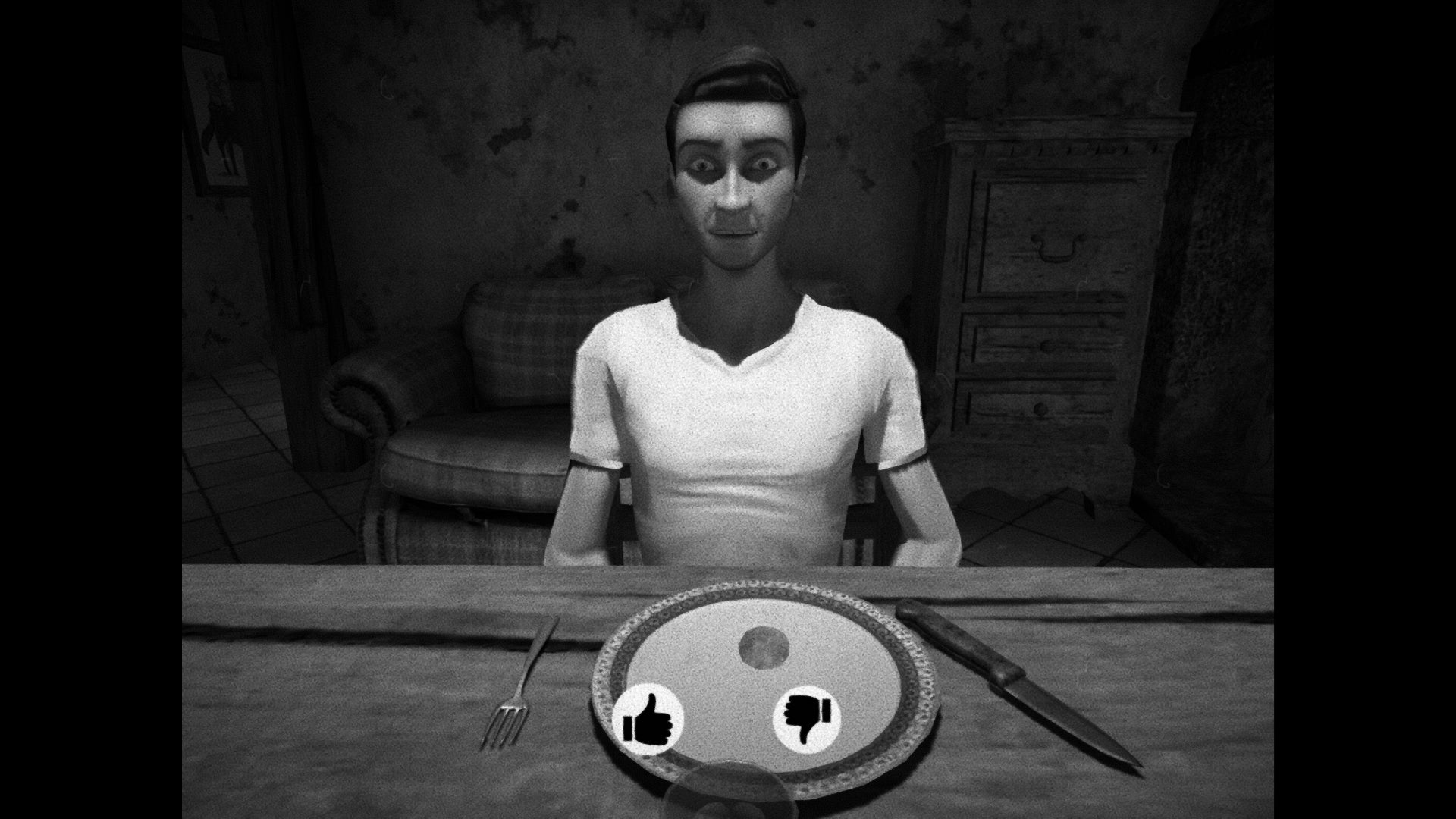
The only thing more unnerving than the “horses” is the Farmer. He is how Shrek might appear in David Lynch’s Eraserhead, an ogreish fatberg in creased and bulbous overalls, his eyes diabolically frail and white beneath his screwed-on hat, his teeth slightly bared as he looms over you in dialogue. He is an abomination – but he is also your host, the person who prepares your meals and pins a list of chores to the wall outside. These tasks range from feeding the farm’s “dog” to forcing a “horse” to pull a plough, all performed by clicking on things, with absolutely no “skill” element beyond deciding how much revulsion to express in dialogue with the Farmer. In the process of doing your dailies, you also learn a little more about the situation on the Farm, and naturally, you look for opportunities to misbehave.
Above all else, you are instructed not to let the “horses” have sex, because the Farmer is both horribly lustful and mortally afraid of sex, to the extent that his own desires have become indistinguishable from his terror, and must be handed over to others to perform. When intoxicated after dark, he has his “dog” rape and abuse the “horses” while he himself stands aside in costume and a chastity belt, fumbling at his thighs.
These nocturnal scenes are hard to distinguish from your own dreams, as you fall under the Farmer’s spell. It’s swiftly apparent that he sees you as an heir, to be moulded through graft and other ceremonies of dominance, especially the sharing of food. The three biscuits he bakes you for breakfast are stamped with symbols of the previous day’s obscenities. Gulping all three down is a squeamish little schoolboy rite of acceptance, like humming the melody for a racist nursery rhyme. Shunning them has no penalty, as far as I can tell – you can get by without breakfast – but feels like a dangerous provocation.
The Farmer’s weaponisation of mealtimes notwithstanding, Horses is possibly more revolted by eating than sex, inasmuch as it seems unsure how to contain and punish the sensuality of eating. At dinner you’re treated to sickly accelerated visuals of smacking lips and teeth, with sound effects that never quite match what you’re eating.
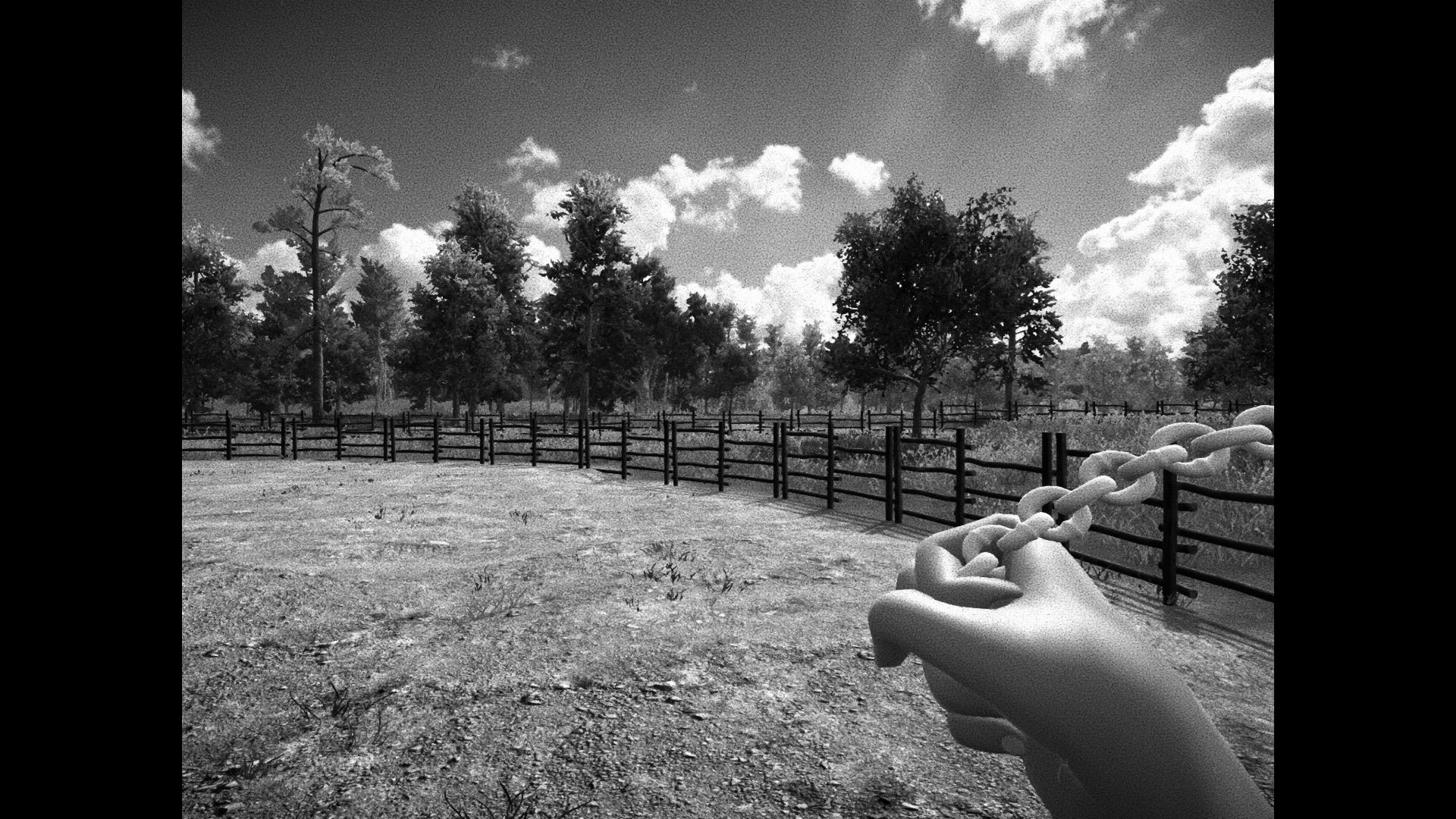
For most of the game, your agency as player is required only inasmuch as this allows you to be disempowered. Refuse the Farmer – whether it be saying no to a second helping of meat, or declining to castrate a pinioned “horse” – and he’ll jovially insist, and the game won’t let you refuse again. Perhaps the aim is to test whether you’re willing to say no regardless, or perhaps Horses simply needs you to think you have free will, so that it can get off on the thrill of denying you.
The “choices” are about investigating your own impotence, in other words. Later on you acquire a gun, videogaming’s favourite “verb”, but no ammunition. The gun is eventually used by somebody else, and not as a gun. There’s also a “save the damsel” subplot, videogaming’s other classic verb, but this is thwarted and respun as a softcore daydream, with the Farmer rubbing his thighs from the other side of a screen as he watches you abscond with the “princess”.
The above scenario is a reminder of the projector clattering away behind you, the player of Horses. That projector and the Farmer are one and the same abuser. The machine discharges his pious, voyeuristic need to be estranged from his own sexuality, to experience it as a moving picture. The game’s many rapes, beatings and scenes of self-flagellation are appropriately machinic and abortive, the beginning and end of each animation failing to knit. It’s like watching somebody trying to remember how to jerk off, automatic and listless, even subjectless. The suffering isn’t really inflicted by a character, but unthinkingly enacted by the game’s own technology. However vile the pixel-bruised imagery of welts and amputations, the mayhem is always structural and in a bizarre way, disembodied, even dispassionate. It is merely the action of this world. It just… is.
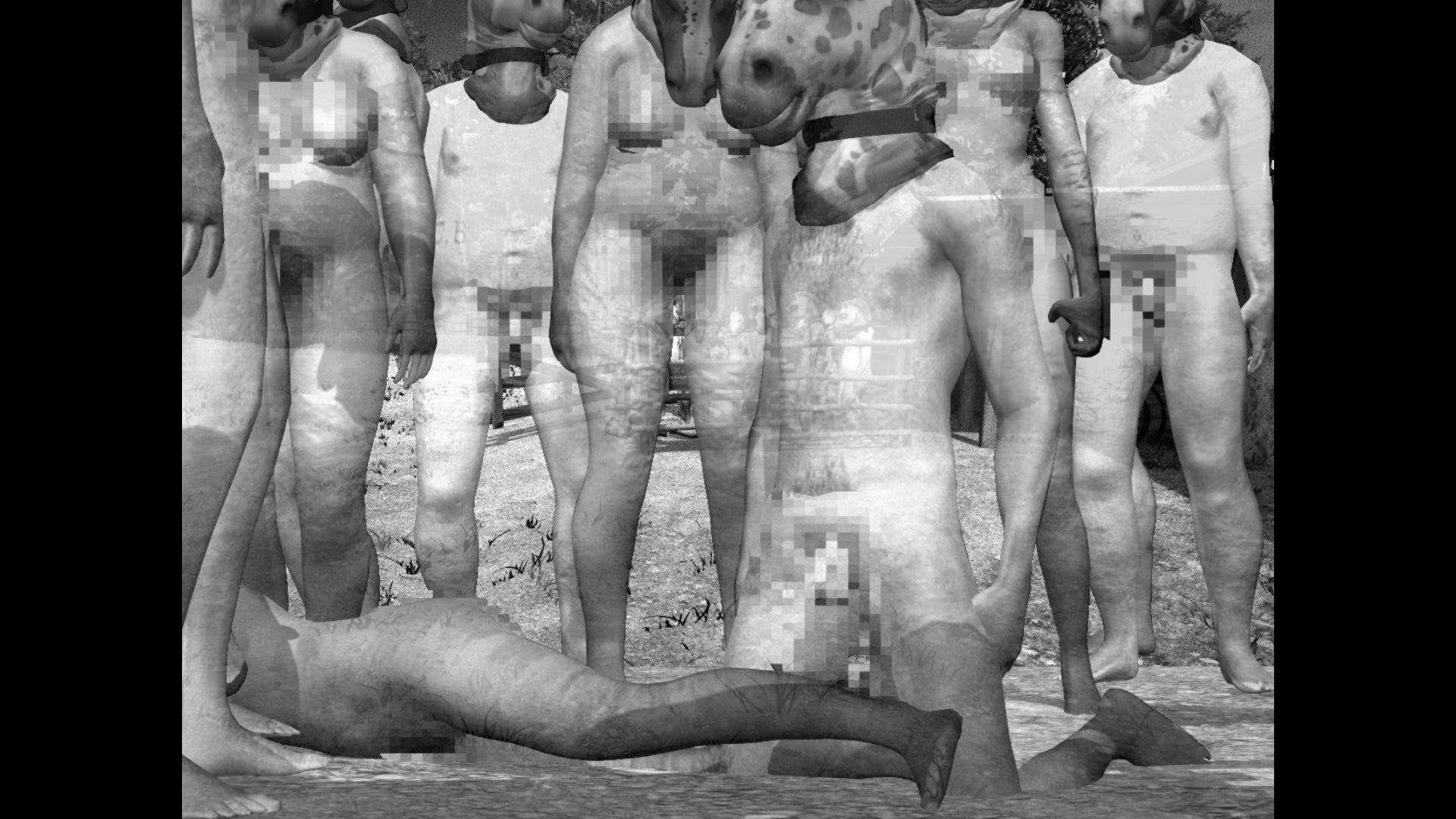
I wonder if that reflects primary developer Andrea Lucco Borlera’s debts to Surrealist film, which – here and in general – risk being reduced to the commonplace idea of the surreal as simply “weird”. I’m no student of Surrealist cinema, but if I take anything from, say, The Seashell and the Clergyman, it’s that there are no people in those artworks. There are only images carried and convulsed by subconscious flows that are at once revealed and hidden by the camera. In practice, however, this framing doesn’t quite apply to Horses, which does have a plot and individual characters with histories mentioned in scattered letters and dialogue, and there is naturally the risk of too-easy exculpation in the suggestion that the violence is structural, not individual – a risk that needs to be investigated, because individuals as awful as this do exist, and Horses is broadly a story about refusing to become one.
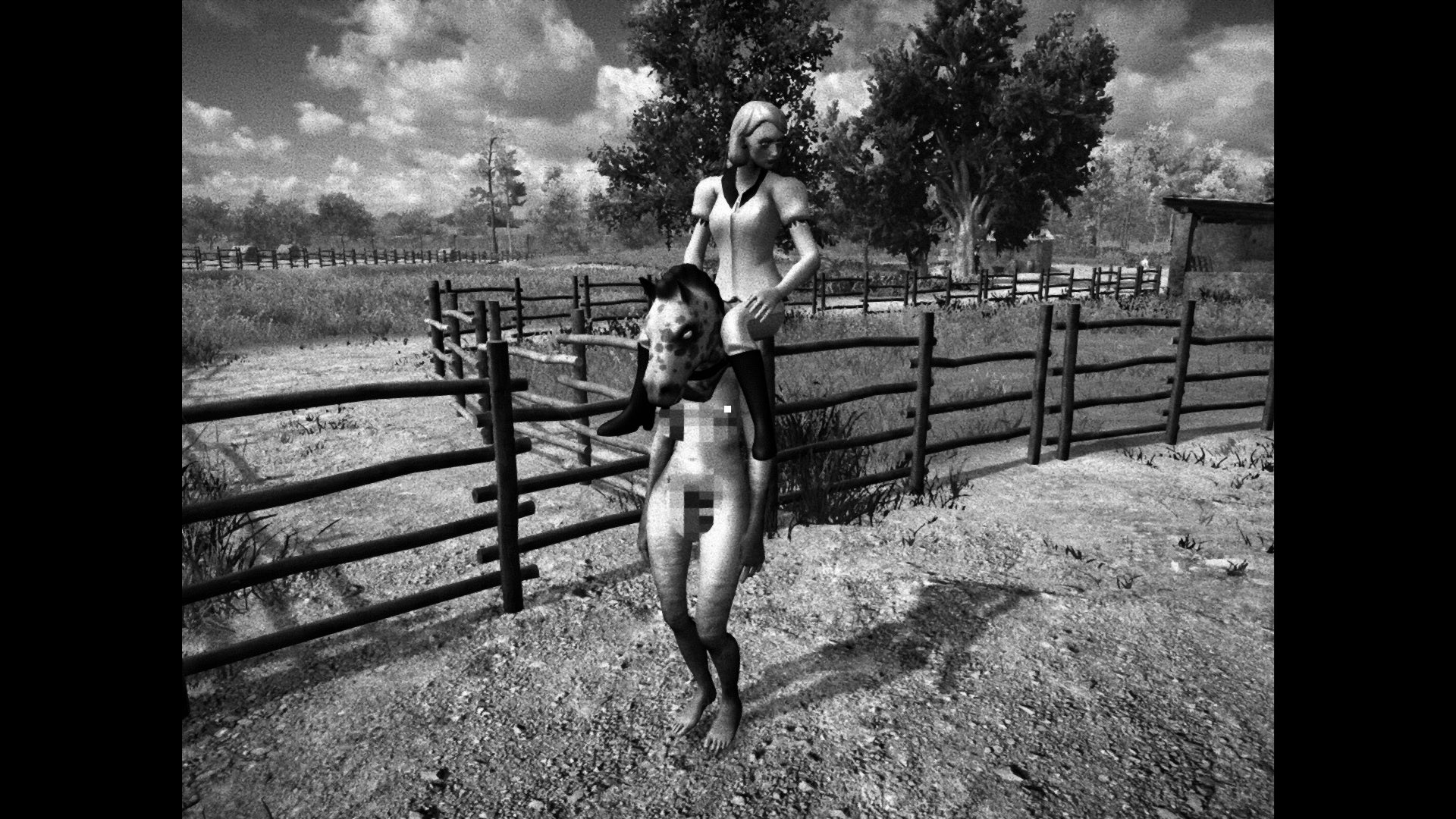
It isn’t just the Farmer: at intervals the Farm has visitors, including a supplier and his garishly made-up adult daughter, all of whom appear comfortable with the carnage, inasmuch as they allow themselves to perceive the violence as violence and the “horses” as people. When the Farmer and his buddies discuss the euphemistic ‘deviancy’ they wish to punish, they refer primarily to religion, but ultimately to the crushing machinery of common-sense morality, what ‘everybody knows’. As the supplier’s daughter tells you, while literally riding on the shoulders of a naked slave: “the way they used to live… a lot of people find that unacceptable. I don’t care, personally. But usually, people exhibiting immoral behaviour also have dangerous ideas.”
The supplier’s daughter is a tricky figure because she is both the voice of the censor – her callous remarks an elaboration of Steam’s storewide prohibition on “content that is patently offensive or intended to shock or disgust viewers” – and also, the probable reason for Steam declining to platform the game. Inasmuch as can be told from Santa Ragione’s own account of events, an earlier, work-in-progress build of Horses featured a version of the character the platform holder’s content reviewers deemed to be plausibly underage, with Valve telling Santa Ragione “we will not distribute content that appears, in our judgment, to depict sexual conduct involving a minor”.
In choosing to make this fact public before release, and accuse Valve of censorship while defending their game against the charge of child sexual abuse material, Santa Ragione have struck a Faustian bargain. On the one hand, Horses now has a profile it likely wouldn’t have had, if the developers had released it on other storefronts without comment. On the other, the game we have today is haunted by an earlier, seemingly vanished version of itself that is now the subject of widespread speculation – in good and bad faith.
The complexity here is that Horses is about the sexuality of younger people, even if none of the characters are actually minors. The Farmer is the way he is because of how he was raised – there are doodles and a home video that obviously date back to his early teenage years – and now, he is trying to pass those brutal values onto you. The moral is about how puritanism may reproduce across generations, even when taken to the extent that congress becomes impossible, which necessitates certain other, shambolically crude and fantastical approaches to securing a legacy. That your character is a legal adult is a technicality: the game frames you as a mute child, peering up at the Farmer while eating, struggling to say no by means of emojis and shakes of your head. It’s easy to imagine the fable playing out exactly the same way if the protagonist were in their early to mid teens.
Still, I can only comment on the game I’ve played. “Dangerous ideas are a concern for everyone,” the supplier’s daughter tells you. “Because if the machine jams, everything falls apart.” That’s what bodily reproduction is in Horses – a jamming of the mechanism of audiovisual reproduction that performs this social order, that preserves the abysmal mutant sterility of this awful world. The camera fucks. The participants are props, scenery, special effects.